
By Alanna Christiansen and Fiona Roscoe
While Racing & Wagering WA (RWWA) and Greyhounds WA celebrate the official opening of the new Cannington greyhound track on the night of the Perth Cup (23 April 2016), the ever-increasing number of people strongly opposed to greyhound racing will stage a historic first-ever protest outside the gates of a WA greyhound racetrack. Here’s why they are rallying:
State Government’s Support of a Cruel Dying Industry
WA’s state government is propping up a moribund industry that has no social licence to continue. The people are frustrated that $13 million was approved by the state government for the development of the new Cannington greyhound track. Greyhounds WA’s own strategic plan clearly demonstrates the failure of the industry to sustain itself in modern times due to increased public awareness and intolerance of unacceptable animal welfare standards.
Too Many Bred, Too Many Dead
The anti-racing movement is gathering pace following the horror stories about this industry which have come to light following the live baiting scandal and the NSW Special Commission of Inquiry into greyhound racing. The commission found that the industry is responsible for the unnecessary deaths of up to 17,000 young healthy greyhounds every year. These figures were estimated by the peak body Greyhounds Australasia.
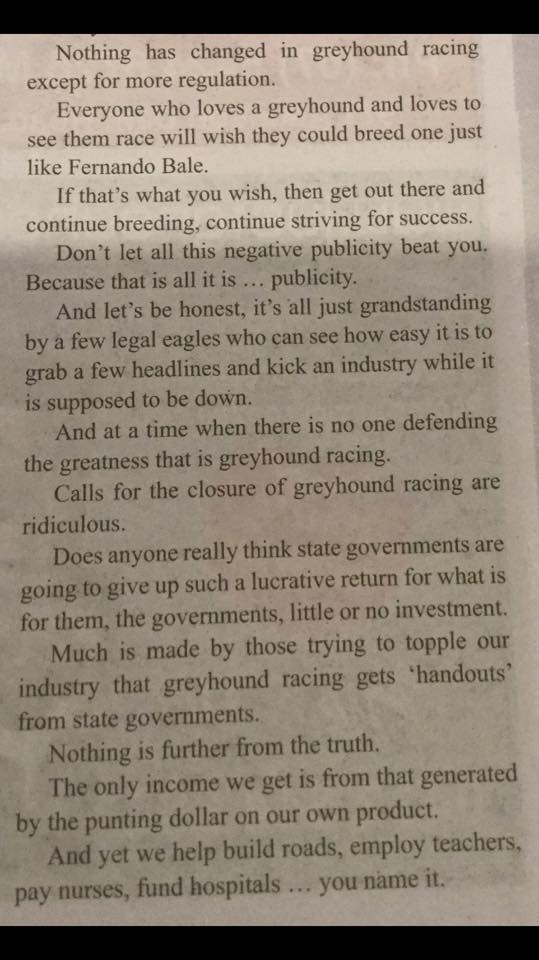
It is acceptable practice within greyhound racing to euthanise healthy dogs for substandard performance or because rehoming is too difficult. This industry relies on overbreeding dogs on an ongoing basis to achieve financial viability. Have a look at this article from The Chase, a greyhound racing magazine, which advises participants to just keep breeding greyhounds until they get a winner. No thought is given to what will happen to all the dogs that don’t win.
Industry participants have no formal responsibility for the fate of the dogs once their racing career is over or never began. Industry-run greyhound adoption programs are underfunded and rehome only a small percentage of dogs bred to race. In early 2013 GAP WA celebrated rehoming their 1000th dog after over 12 years in operation. According to Greyhounds Australasia between 2003-2012 approximately 6198 pups were produced in WA. The WA industry has taken no responsibility for the lives of thousands of dogs to date. Greyhound Racing Victoria claims to have the most successful industry adoption program in Australia, but they took 20 years to rehome 6,100 greyhounds while producing roughly 6,588 puppies every single year. No wonder they felt the need to lie about adoption figures.
Non-industry rehoming groups run by volunteers achieve higher rates of successful rehoming despite receiving no financial support from the industry. These groups rely on the passion and dedication of volunteers who tirelessly campaign, foster and fundraise for the dogs in their care. They are often overwhelmed with industry ‘wastage’ and willingly give their own time and money to urgent rescues – unlike the people causing the problem in the first place.
Unacceptable Risk of Injury and Death
Greyhounds WA boasts that the new track has “state of the art features and safety advancements”, but in reality such features do little to reduce the inevitable and unacceptable risks to the dogs’ safety and indeed lives. The Cannington track closely follows the designs of Northam and Mandurah, where 367 greyhounds were injured (including 22 euthanised as a result of injuries) in a 4-month window from November 2015 to February 2016 according to published stewards reports. A dog has already been euthanised at the new Cannington track after sustaining a fractured hock on 13 Apr 2016.
[vimeo 161604455 w=500 h=273]
Brother died after fracturing his skull at Northam track (4 Apr 2016)
Deaths at the track are not isolated to WA either. In NSW, GRNSW found that one greyhound was dying at its tracks every two days. Regardless of track design, many injuries are attributed to repetitive stress on the dogs’ bodies from racing repeatedly beyond their physical capabilities.
“There’s only a certain number of circle runs in every dog, and sooner or later you’ll reach that point where structures that are repeatedly subject to stress will fatigue and fail” explained a veterinarian whilst giving testimony at the NSW Special Commission of Inquiry.
It’s obvious that greyhound racing breaches the Animal Welfare Act 2002 that states “(1) a person in charge of an animal is cruel to an animal if the animal – (c) is worked, driven, ridden or otherwise used – (i) when it is not fit to be used or has been over used; or (ii) in a manner that causes, or is likely to cause, it unnecessary harm”. The proposed on-site vet clinic at stage two of development at the Cannington track, after racing has already commenced, will be of little comfort to those dogs who will inevitably sustain injuries that interfere with their racing ‘career’.
A Failure in Welfare
Another veterinarian giving testimony at the NSW special commission of inquiry mentioned, “it’s common practice for greyhounds to spend a significant period of their adult life under conditions of individual housing, which is unacceptable from an animal welfare standpoint. Dogs are highly social animals and single housing eliminates their ability…to express normal behaviour”.
The impact of restrictive high-stress environments with little or no socialisation is often evident in adopted dogs and reported by foster carers and adopters. Subsequent behavioural issues often result in ‘too difficult to rehome’ dogs. The inevitable fate for these dogs is a premature death, unless they are lucky enough to be intercepted by an independent rescue group. The industry’s adoption programs are only able to deal with dogs without behavioural issues, due to the significant costs associated with rehabilitation to pet life.
Doping Dogs Rewarded, Not Punished
Dogs face doping with illegal performance-enhancing or disabling substances. The longer-term health effects are dismissed, as demonstrated by the paltry penalties handed down by RWWA. Last year, repeat offender Linda Britton was crowned WA’s leading trainer award just weeks after she was charged with doping offences. Actions speak louder than words and it is blatantly clear by actions such as this the welfare of the dogs is not of the highest priority.
Exported to Their Deaths
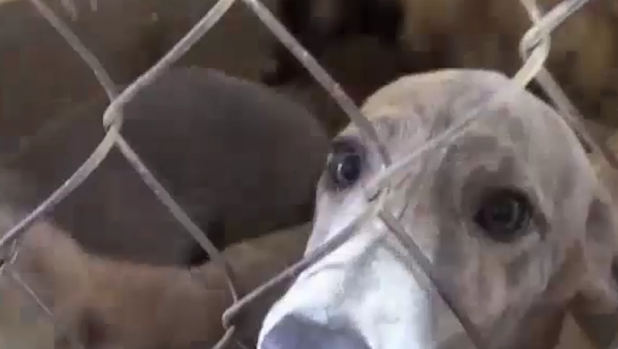
Greyhounds have been regularly exported to Asian countries in contravention of the self-regulated industry ‘guidelines’ for years. Despite these countries having no animal welfare laws and the fact that the dogs live in squalid conditions and are guaranteed to be euthanised at the end of their racing careers, participants were clearly unconcerned as long as they could make a quick buck.
This practice was happening as recently as late last year, until the Animals Australia expose and subsequent airline refusal to export greyhounds following public pressure. The state government continues to deny this practice ever existed in WA despite solid evidence to the contrary. Greyhounds Australasia continues to blame the federal government for its inability to enforce its rules against exports. This is illustrative of the ongoing failings of a self-regulated industry.
Tainted With Corruption
As if these animal welfare issues are not enough reason to ban greyhound racing, internal documents from Greyhound Racing NSW (GRNSW) suggest the governing body was aware for years that live baiting was occurring. Racing stewards were also told to “desist” from reporting injuries and subsequent deaths because of the “pretty bad publicity” they’d had recently. Emails from GRNSW were uncovered revealing the governing body was tipping off live baiters prior to investigation. Most people not convinced these findings are solely NSW issues, but nationwide.
For example, after the live baiting scandal in Feb 2015 and reports of live baiting occurring in WA, RWWA conducted an investigation into live baiting. The RSPCA WA accompanied inspectors to “some” properties (an exact number was not recorded) and RWWA concluded there is no live baiting occurring in WA. However, when Racing Minister Colin Holt was asked in parliament for the official investigation report, he replied “there is no official report”.
Had the RSPCA WA conducted this investigation independently without notice prior, the public would be relieved by the results. RWWA’s investigation was poorly executed, to say the least.
Shut It Down
Gambling and animals are a toxic mix. As long as there’s a desire for monetary gain, the welfare of the dogs will never be paramount; dogs are ‘products’ and must be profitable in order to ensure a sustainable business. This industry is wholly reliant on gambling revenue and as such, the business model decrees that animal welfare standards can never be compatible with modern society expectations.
The greyhound racing industry attempts to portray itself as an ethical family-friendly activity while actively aiming to minimise and obscure damning internal statistics from the public. Unfortunately for them, there is a growing collective of people who see through this façade. We will no longer accept the treatment of these beautiful dogs as commodities to be disposed of at the whim of the trainers and owners. While the RSPCA WA and the state government continue to turn a blind eye to greyhound racing’s welfare inconsistencies, offences and breaches, the dog-loving public see the necessity to be a voice for these dogs.
Protest organisers aim to increase public awareness of the long suppressed truths of greyhound racing and hope to influence the state government’s decisions to fund the industry further. By taking a stand and voicing our concerns, we will cause ‘The Beginning of the End of the WA Greyhound Racing Industry’.