
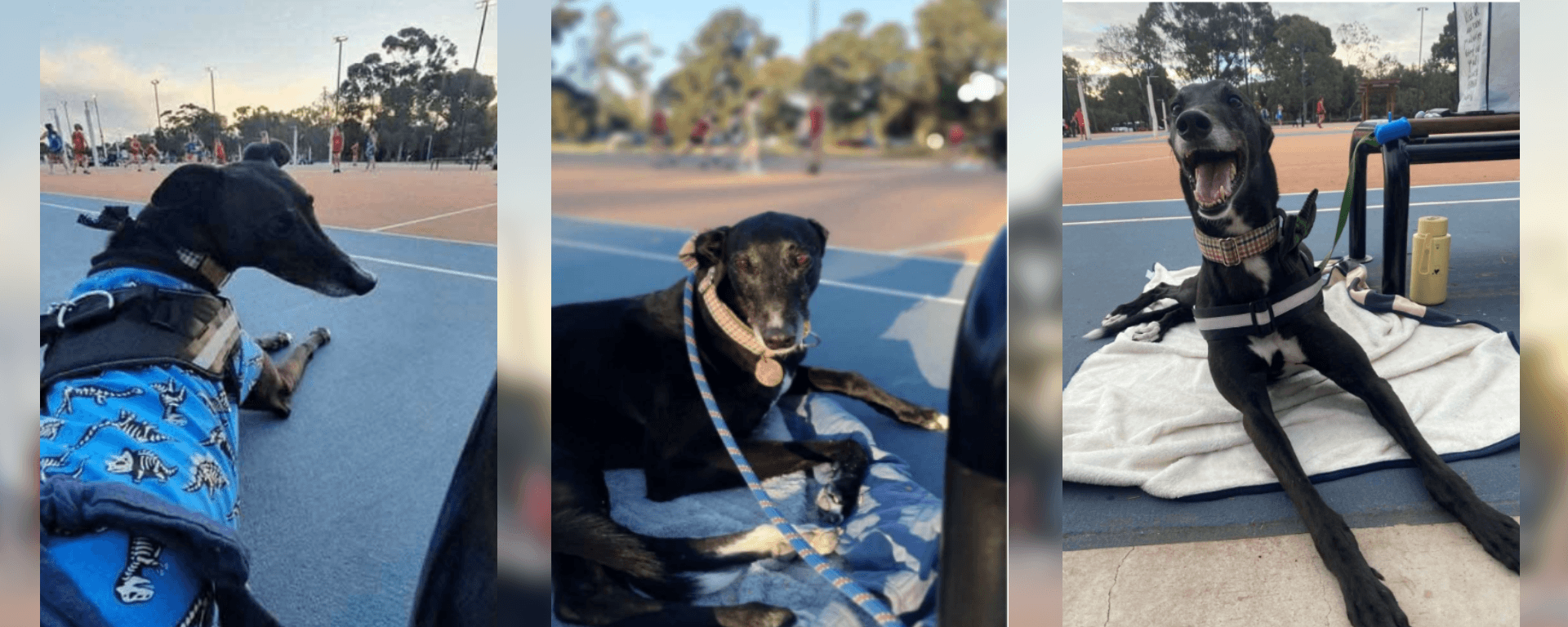
Photos: King the greyhound, courtside, cheering the team on
Dear Minister Pearce,
I’m writing as a South Australian taxpayer, someone who cares deeply about animal welfare and the fair use of public money, and as a person who does not support greyhound racing.
I also share my life with a rescued greyhound, King, so this is an issue I see both personally and through lived experience.
I’ve been looking at how greyhound racing is funded in this state, and I’m struggling to understand how the current system aligns with what most people would consider fair or proportionate.
My understanding is that the Point of Consumption Tax (POCT) is collected on wagering activity across all sports, not just racing. In South Australia, this is estimated to generate hundreds of millions in wagering turnover annually, with a significant share coming from mainstream sports such as AFL, basketball, golf, and major events like Gather Round and LIV Golf.
Yet despite this, a portion of that tax base (20%) is effectively redistributed back into racing codes, including greyhound racing, through industry funding arrangements.
From the outside, this creates a sense that revenue generated by community sport and major events is helping sustain an industry that many people in the community do not support, without any reciprocal return to those sports or community programs.
As someone who has played country netball in Penola my whole life, I find this deeply upsetting. Community sport in regional South Australia runs on dedicated volunteer effort, limited resources, and strong community spirit. To see significantly larger public funds flowing into a gambling-driven industry, while grassroots sport continues to stretch every dollar, does not sit comfortably with me.
I also can’t reconcile the scale of investment flowing into greyhound racing compared to grassroots sport. For example, the Gather Round legacy fund recently committed around $3.2 million to community football infrastructure across the state. At the same time, public and government-related support for greyhound racing has increased significantly, rising from approximately $727,000 in 2019 to over $4.3 million in recent years. As a taxpayer, that gap is difficult to understand.
Another point that stands out is how the POCT operates. Because it is collected on gambling activity based on where the bet is placed, not the event itself, South Australia receives revenue regardless of whether people are betting on local greyhound racing or international sporting events. That raises a question about why continued high levels of public funding are required to sustain greyhound racing infrastructure if the underlying tax base is not dependent on the industry’s local activity.
There is also a broader concern about incentives for the industry to perpetuate gambling harm in the community.
When funding is linked to wagering turnover and market share, it appears to encourage a focus on race frequency and betting volume. That creates a system where financial sustainability is tied closely to gambling activity, which raises serious questions for me around priorities, particularly in relation to animal welfare and long-term industry direction.
Finally, I’ve seen estimates that while the entire racing sector (thoroughbred, harness and greyhound) claims close to 1,000 full-time equivalent roles, broader ABS data suggests the industry is closer to around 600 with most of those roles tied to thoroughbred. Government reviews such as the Ashton Review note that approximately 71% of participants in the greyhound industry are hobbyists and that the workforce is largely ageing.
I understand many in the industry are of a similar generation to my parents and have spent their working lives within it, so I am mindful to not dismiss that lived experience and recognise that, for many, this is simply the system they have known.
However, at the same time that system has operated for a long time with limited external scrutiny and within an insular culture that has not kept pace with modern community expectations and standards.
Increasingly, the public is rejecting, as reflected across Australia, this status quo, particularly where it continues to result in avoidable harm to greyhounds used in gambling. In that context, “the way things have always been” is no longer a sufficient justification for ongoing public support.
I think it is reasonable for the community to ask whether ongoing public support for greyhound racing is still justified in its current form. From my perspective, it is not. I do not want my tax dollars contributing to this industry. I also believe those funds would be far better directed toward community sport, regional facilities, and animal welfare outcomes that reflect modern community values.