Greyhounds as slaves

by Warren Young, Coalition for the Protection of Greyhounds

Free the Hounds is a Western Australian volunteer group that advocates for the freedom of greyhounds and the end of commercial greyhound racing.

They gather insightful information in various forms to educate the public about the perils of greyhound racing. One of their forums is a podcast Talking Couch Potatoes, which recently presented the idea that unlike other dog breeds, greyhounds are slaves to the racing industry. Let’s look at this in more detail.

A slave is usually associated with humans, and can be described as “a person who has the legal status of being the property of another, has no personal freedom or rights, and is used as forced labour or as an unpaid servant.” This definition can also apply to greyhounds that are born to serve humans, work for humans, and reused for many human purposes. 

While we recognise the seriousness and gravity of historical and modern slavery, there are themes that can be applied to the abuse of animals.

No freedom

Racing greyhounds do not have the freedom to run when they choose to. They are forced to train and race when it suits industry participants. Owners and trainers like to tell the public that greyhounds love to run and chase, and they are providing an outlet for their dogs to follow their instincts.

Greyhounds do love to run and chase like many other dog breeds. But this is only free when it is voluntary, playful, spontaneous, random, and when the dog chooses to stop. That instinctive behaviour is nothing like commercial greyhound racing, where dogs have to chase a mechanical lure around a curved track against a bunch of other dogs.

This is contrived activity when it suits industry participants and punters purely for the purposes of betting.

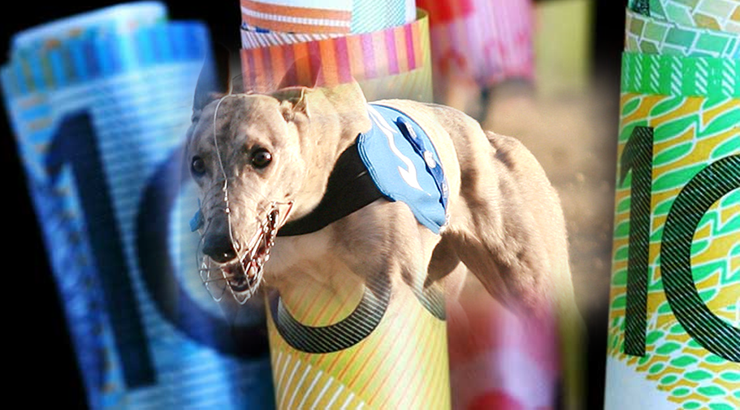
Greyhounds are bred in huge numbers only for the purposes of gambling on races. Let’s be clear, without gambling, commercial greyhound racing would not exist.
The life of a greyhound in Australia

Greyhounds are bred in huge numbers only for the purposes of gambling on races. Let’s be clear, without gambling, commercial greyhound racing would not exist. When a greyhound litter is bred, a trainer will then prepare dogs for racing. This early life is not the same as a dog bred as a companion, and can involve a lack of stimulation and enrichment leading to poor socialisation and anxiety.

Some of a litter will go on to race and have a “career”. Others will never race, because they are either too slow or don’t possess the compliant temperament needed for a life of competition. The dogs that end up racing will be given a name, but the non-racers will remain nameless and be of little use to the industry. So, what happens next?

Racing greyhounds

Like any commodity, the worth of a racing greyhound depends on its ability to generate income for its owners. Highly successful dogs will likely be provided with good food and health care in an attempt to maintain their value. However, racing greyhounds always faces a risk of serious injury or even death. This is not really surprising when you require up to eight dogs to sprint around bends, resulting in bunching and physical contact. Falls can be catastrophic, leading to euthanasia. Racing participants accept the death of their dogs as “part of the game.”

If a prize winning dog is  injured and can no longer race, it could be sold for breeding. If not used for breeding, the value of the dog plummets, and they could become a financial burden to their owner. In this case, they will likely be surrendered to a community voluntary rescue group, since the industry rehoming groups cannot cope with the large numbers of discarded dogs. If they are lucky, they might be adopted by a family as a pet. If they are deemed unable to be rehomed due to behavioural issues, they may be legally euthanised by a vet.

However, racing greyhounds always faces a risk of serious injury or even death. This is not really surprising when you require up to eight dogs to sprint around bends, resulting in bunching and physical contact.
Non-racing greyhounds

A greyhound that never raced has no value to the industry. It’s not suitable for breeding, so must eventually be surrendered. It might be given up to be “homed.” The word “rehomed” is not really accurate because greyhounds do not start their life in a home, but rather a training facility. The lucky ones might end up as a family pet. If not so lucky, a greyhound might be sent interstate or overseas, or might be given to a University for scientific experimentation, or to have its valuable blood used to assist other animals.

A greyhound that never raced is not likely to be provided with a healthy diet or be well maintained because of the cost to the owner. So, when surrendered for homing, many dogs are found in poor physical and mental condition, and this makes homing more challenging.

Regardless of any racing history, there is a point in the life of every greyhound when it is discarded by the industry. This reinforces the status of greyhounds as slaves. The day when commercial greyhound racing comes to an end across Australia will signify releasing the shackles of greyhounds as slaves. Only then, can greyhounds  live a life with dignity like other dog breeds.